
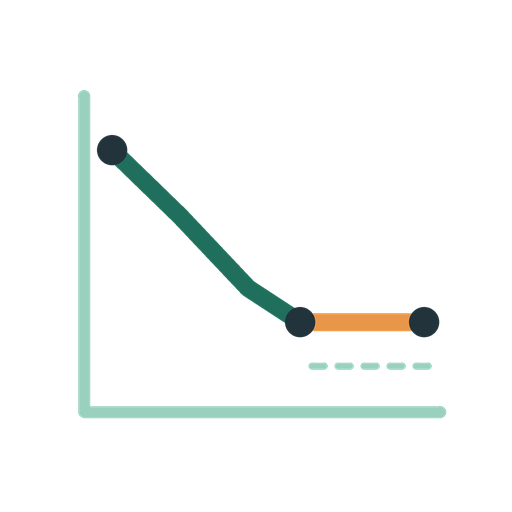
The first weeks are exhilarating, then the scale freezes. This is the moment most people quit, convinced their metabolism is "broken". The reality is more nuanced — and considerably more encouraging.
A Remarkably Consistent Phenomenon
The plateau typically emerges six to eight months into a weight-loss programme, with individual variation. A recent review notes that metabolic adaptations contribute: reduced intake lowers every component of total energy expenditure, while restriction increases appetite and hunger. These two converging movements create an energy gap that gradually closes the deficit.
But there is a timing problem. Validated mathematical models of energy balance predict a plateau at one to two years, not six months. Where does the discrepancy come from?
The Uncomfortable Answer: Adherence
One team built two competing models to explain the early plateau. The first assumed massive metabolic adaptation; the second, fluctuating dietary adherence with intermittent lapses. The verdict: metabolic adaptation raised the final weight reached, but did not change when the plateau occurred. The intermittent-adherence model, by contrast, reproduced exactly the oscillating curves seen in clinical trials and generated a plateau at six months.
The authors conclude that an intermittent lack of dietary adherence, not metabolic adaptation, is a major contributor to the frequently observed early plateau. The model also shows that a six-month plateau can occur despite what would be considered high adherence.
This is not an accusation of laziness; it is a finding. Nobody follows a plan 100% for six months, and the arithmetic alone explains what is usually blamed on a failing metabolism.
Three Checks Before Declaring a Plateau
1. Duration. Weight fluctuates by one to two kilos with hydration, carbohydrate intake, the menstrual cycle and digestion. A plateau is judged on three to four weeks of weekly averages, not three weigh-ins.
2. Portion drift. It is gradual, unconscious and universal. A few days of precise weighing usually reveals the gap.
3. Expenditure. A lighter body spends less on the same activities. The deficit you set six months ago is no longer the deficit you have today.
Seven Ways Out of a Plateau
- Measure before acting. Three to seven days of accurate tracking beats intuition.
- Recalculate the deficit from your current weight, not your starting weight.
- Raise expenditure rather than cutting further, particularly through daily walking.
- Protect muscle: protein and resistance work, so the plateau does not become disguised muscle loss.
- Track other indicators: waist circumference, photos, how clothes fit, performance. The scale is a noisy instrument.
- Consider a maintenance break of two to four weeks. It restores adherence and makes the next phase more effective.
- Do not answer a plateau with extreme restriction. It is the most common reflex and the one that best sets up regain.
The Takeaway
A plateau is not a metabolic verdict but a predictable waypoint. Getting past it almost never requires a harsher diet: it requires honest measurement, a modest adjustment, and sometimes simply time. What decides the final result is not what happens in month six, but what you do in month twelve.
Sources
- Thomas D.M. et al., Effect of dietary adherence on the body weight plateau: a mathematical model incorporating intermittent compliance with energy intake prescription, Am J Clin Nutr 2014;100(3):787-795: https://pmc.ncbi.nlm.nih.gov/articles/PMC4135489/
- Weight Loss Plateau: Reasons, Challenges, and Solutions: A Narrative Review: https://pubmed.ncbi.nlm.nih.gov/42466371/
- Hall K.D., Physiology of the weight-loss plateau in response to diet restriction, GLP-1 receptor agonism, and bariatric surgery, Obesity 2024: https://onlinelibrary.wiley.com/doi/10.1002/oby.24027
- Sumithran P. et al., Long-Term Persistence of Hormonal Adaptations to Weight Loss, N Engl J Med 2011: https://pubmed.ncbi.nlm.nih.gov/22029981/